The King County neuroscience ecosystem’s structure is characterized by a high degree of concentration and interconnectedness, which profoundly influences local research and clinical collaboration, fostering both fundamental discovery and translational progress.
This influence stems from the interplay between a central academic and clinical hub and a unique, globally recognized independent research institute.
I. The Core Structural Components
The ecosystem’s structure is anchored by two major forces, complemented by specialized clinical centers:
- The University of Washington (UW) Hub: The UW system serves as the cornerstone of the region’s neuroscience activities, integrating research, education, and clinical practice across multiple colleges (Arts and Sciences, Medicine, Engineering). This hub extends its reach through the UW Medicine Neurosciences Institute, which operates across several major medical centers, including UW Medical Center (UWMC), Harborview Medical Center (HMC), the VA Puget Sound Health Care System, and Seattle Children’s Hospital, ensuring broad patient access and diverse clinical exposure for trainees.
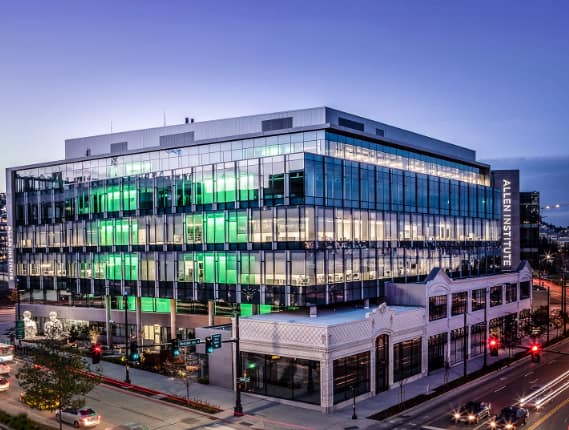
- The Allen Institute for Brain Science: This institute operates as a major independent, non-profit organization focused on large-scale, systematic foundational research. Its mission emphasizes “team science, big science, and open science,” which influences collaboration by making vast datasets, tools, and resources publicly accessible to thousands of researchers worldwide.
- Specialized Clinical/Research Partners: These include Fred Hutchinson Cancer Center (Fred Hutch), which focuses on neuro-oncology, and strong clinical neuroscience programs at the Swedish Neuroscience Institute (SNI) and Valley Medical Center Neuroscience Institute.
II. Influence on Collaboration and Interdisciplinarity
A defining characteristic of this landscape is the high degree of interdisciplinarity and collaboration, which is actively built into the institutional structure.
A. Inter-Institutional Integration (Clinical and Research Translation):
The physical and operational alignment of institutions accelerates the application of research findings to clinical practice.
- Clinical Integration: The UW Medicine Neurosciences Institute ensures comprehensive care by operating across multiple major medical centers in the county. For example, the Department of Neurology provides training experience across UWMC, Harborview, the VA, and Seattle Children’s.
- Research Partnerships: UW, Fred Hutch, and Seattle Children’s demonstrate clinical and research integration. Fred Hutch, which focuses on neuro-oncology, collaborates closely with UW Medicine, serving as its cancer program, and partners on facilities like the Alvord Brain Tumor Center at UWMC.
- Basic Science Support: The Allen Institute’s structure includes a Frontiers Group that funds external Allen Discovery Centers, with one initiative involving UW Medicine, facilitating collaboration between the independent research giant and the academic hub.
B. Intra-Institutional Interdisciplinary Research:
The UW system is structured around several interdisciplinary centers that explicitly mandate collaboration across departmental boundaries.
- Center for Integrative Neuroscience (CIN): This center is mandated to foster collaborative research on neural function, drawing faculty (estimated 60–70 members) from departments across the College of Arts & Sciences, the School of Medicine, and the College of Engineering.
- Stroke & Applied NeuroScience Center (SANS): SANS is a key example of multidisciplinary collaboration, integrating expertise from Neurological Surgery, Radiology, Neurology, Nursing, Pathology, Anesthesiology, Mechanical Engineering, and Bioengineering to focus on stroke and cerebrovascular disease.
- Computational Neuroscience Center (CNC): The CNC acts as a campus hub connecting theoretical and experimental neuroscientists, spanning departments such as Physiology and Biophysics, Applied Mathematics, Statistics, Computer Science, and Biology.
C. Cross-Pollination Through Shared Appointments:
The collaborative structure is reinforced at the individual level by the prevalence of neuroscientists holding joint or adjunct appointments across different departments or institutions. This “cross-pollination of expertise” likely fuels the collaborative environment. Examples include:
- Individuals with appointments spanning Neurology and Medicine, or Neurology and Pathology (e.g., Suman Jayadev, Stephen Tapscott).
- Researchers affiliated with multiple specialized UW centers (e.g., Louis J. Kim and Michael R. Levitt associated with Neurological Surgery, Radiology, Neurology, and SANS).
- Individuals holding appointments at the Allen Institute and UW (e.g., Christof Koch, Ed Lein, Adrienne Fairhall, Eric Shea-Brown).
III. Impact on Research and Clinical Outcomes
The structure of the King County ecosystem directly supports and generates translational strength in specific areas.
- Accelerated Translation: The structure demonstrates strength in translational research, with numerous advanced diagnostics and therapies developed and applied in clinical settings.
- Defined Expertise Clusters: Collaboration focuses expertise in several distinct areas:
- Foundational Science: Large-scale brain mapping and cell type characterization, spearheaded by the Allen Institute.
- Computational Science: Mathematical modeling and data analysis, centered at the UW Computational Neuroscience Center.
- Clinical Focus: Prominent expertise exists in specific disease areas within the UW network and its affiliates, including neurodegenerative diseases (Alzheimer’s Disease Research Center – ADRC), stroke (SANS), neuro-oncology, and pediatric neuroscience (Seattle Children’s NFCIBR).
In essence, the King County neuroscience ecosystem operates much like a sophisticated circuit board: the University of Washington acts as the central processor, connecting diverse functional units (departments and medical centers) via high-speed data lines (interdisciplinary centers and shared faculty appointments), while the Allen Institute functions as a high-capacity, open-source memory bank, providing fundamental data and resources that all units can draw upon, ensuring that discovery and clinical care are tightly coupled and constantly exchanging information.
The institution that houses the **Norcliffe Foundation Center for Integrative Brain Research (NFCIBR that houses the Norcliffe Foundation Center for Integrative Brain Research (NFCIBR) is Seattle Children’s Research Institute (SCRI).
- NFCIBR is specifically located within Seattle Children’s Research Institute.
- Seattle Children’s Hospital is a crucial component of the King County neuroscience landscape, especially for childhood neurological disorders.
- NFCIBR focuses on understanding the fundamental mechanisms underlying pediatric neurological, neurodevelopmental, and neuropsychiatric disorders.
- NFCIBR is directed by Dr. Nino Ramirez.
- The center is one of several centers within the Seattle Children’s Research Institute (SCRI), which is ranked among the top five pediatric research institutions nationally.