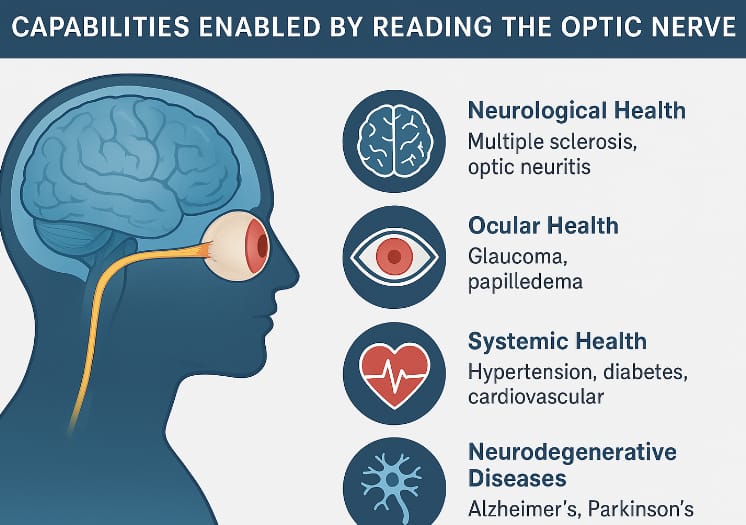
Reading the optic nerve enables critical insights into neurological, ocular, and systemic health due to its direct connection to the brain and role in visual processing. The optic nerve is integral in transmitting visual signals from the retina to the brain, and analyzing it can reveal conditions like glaucoma, optic neuritis, and papilledema (swelling due to intracranial pressure). Beyond eye health, its evaluation offers a window into broader neurological disorders, including multiple sclerosis, where optic nerve inflammation often serves as an early symptom. Advancements in imaging technologies like Optical Coherence Tomography (OCT) allow detailed assessments of optic nerve fibers, enabling early detection of neurodegenerative diseases such as Alzheimer’s or Parkinson’s by identifying changes in nerve thickness or retinal ganglion cells. The optic nerve also reflects systemic health, as vascular changes visible in its structure can indicate hypertension, diabetes, or cardiovascular issues. Moreover, in medical research, studying the optic nerve contributes to understanding neural connectivity and regeneration, providing insights into potential treatments for blindness or nerve damage. Its non-invasive accessibility makes it a valuable diagnostic tool across disciplines, bridging ophthalmology, neurology, and general medicine.
Applications of Remote Sensing (RS) in Relation to the Optic Nerve
Remote Sensing (RS) technology, when applied to the optic nerve, could revolutionize non-invasive diagnostics and monitoring in medicine. By leveraging high-resolution imaging and spectral analysis, RS can capture detailed data on the optic nerve and surrounding ocular structures, offering insights into both localized eye health and broader systemic conditions. For instance, hyperspectral imaging—a form of RS—could detect subtle biochemical and vascular changes in the optic nerve, enabling early diagnosis of diseases such as glaucoma, diabetic retinopathy, or optic neuritis. Additionally, RS technologies could aid in assessing neural degeneration by identifying patterns of thinning in the optic nerve head, which is indicative of conditions like multiple sclerosis or Alzheimer’s disease. Integrating RS with machine learning algorithms could enhance the predictive accuracy of these findings, allowing for personalized risk assessment and disease management.
Beyond diagnostics, RS could be instrumental in monitoring the efficacy of treatments for optic nerve disorders, such as tracking responses to neuroprotective therapies in real-time. It might also be used for screening at scale, particularly in underserved areas, by deploying portable RS-enabled devices to identify optic nerve pathologies remotely, thus democratizing access to advanced eye care. In research, RS can provide insights into the regenerative capacity of the optic nerve by visualizing cellular and vascular dynamics during experimental treatments, contributing to breakthroughs in neural repair and vision restoration.
Utilizing RF Sensing in Relation to the Optic Nerve
Radio Frequency (RF) sensing offers innovative potential in monitoring and diagnosing conditions related to the optic nerve by leveraging non-invasive electromagnetic waves to detect physiological changes. RF sensing can penetrate soft tissues and provide data on neural structures, including the optic nerve, by analyzing variations in reflected signals. This capability could be applied in early detection of conditions such as glaucoma, where subtle changes in the optic nerve’s dimensions or blood flow may be identified. Additionally, RF sensing could monitor intracranial pressure non-invasively, which is critical for detecting papilledema—a swelling of the optic nerve linked to conditions like brain tumors or traumatic brain injuries.
The integration of RF sensing with advanced signal processing and machine learning could enable precise tracking of optic nerve health over time, offering personalized insights into the progression of neurodegenerative diseases such as multiple sclerosis or Alzheimer’s. RF sensing’s ability to detect microvascular changes might also allow early diagnosis of systemic conditions, such as hypertension or diabetes, by examining the optic nerve’s vascular network. Portable RF-based devices could democratize access to such diagnostics, especially in remote or resource-constrained settings, providing rapid, low-cost assessments compared to traditional imaging modalities like MRI.
Furthermore, in research, RF sensing can advance the understanding of neural connectivity and regenerative processes by offering insights into the optic nerve’s structural and functional dynamics under experimental conditions. With continued refinement, RF sensing promises a transformative role in non-invasive neuro-ophthalmic care and beyond.
What are the limitations of RF sensing in neurodiagnostics?