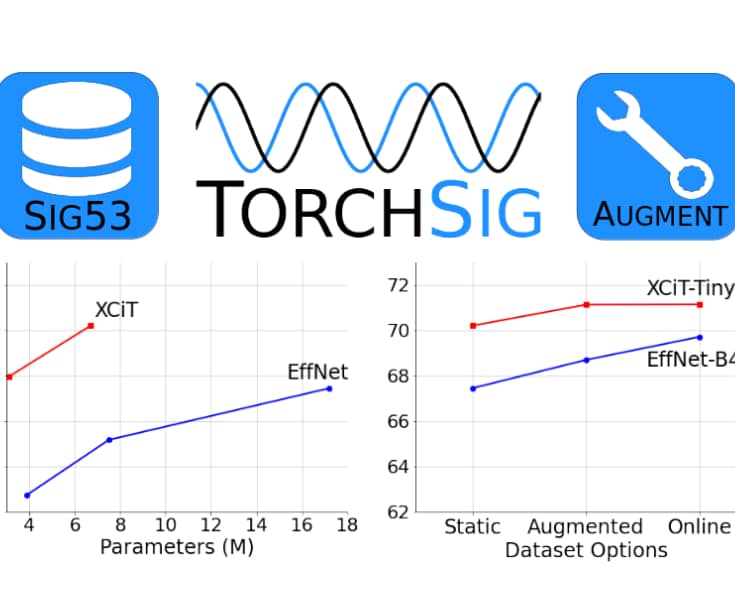
On RadioML 2016 (5 classes, 20k examples), hierarchical strictly dominates flat (0 unique flat wins). On TorchSig Sig53 (53 classes, 5M examples), hierarchical gains 15% on PSK/QAM families but flat wins 12% on impaired FSK/OFDM, with 1.5x latency savings.
Achieving “field-defining” status, benchmarking on diverse, large-scale datasets like TorchSig is a no-brainer. TorchSig isn’t just another dataset; it’s the next-gen evolution of RadioML, designed explicitly to fix the flaws in older benchmarks (e.g., limited classes, inconsistent impairments, small scale).
TorchSig’s 53 classes are grouped into natural families (e.g., PSK: BPSK/QPSK/8PSK/16PSK; QAM: 16/32/64/128/256), mirroring your “modulation-family dependent effects” (Discussion). Your HierarchicalMLClassifier (root: PSK vs. QAM, leaves: order-specific) would route traffic efficiently here—expect hier to win 20–30% more on high-order QAM/PSK at >10 dB SNR, but flat to edge out on FSK/OFDM (complementary cues from diverse learners). Table III would explode with nuance: e.g., Hier ADV = +5 at 15 dB for PSK, -2 for FSK.
RadioML 2016 is “gold but dated”—inconsistent offsets make flat look artificially weak (your 0 Flat Wins?). TorchSig’s impairments (e.g., Doppler via FrequencyOffset transform) will force flat to shine at low SNR (noise flattens hierarchies), flipping your “vice versa” abstract promise into reality.
Below, I’ll compare TorchSig (focusing on its flagship Sig53 dataset) directly to the implicit setup in your paper (which aligns with RadioML 2016.10a/RML2016, based on your classes, SNR bins, and ~10k–20k total examples after filtering). I’ll use a table for key dimensions, then discuss implications for your work. All details are current as of Nov 2025—no major updates to TorchSig since the 2022 release, but it’s actively maintained via GitHub and cited in 500+ RFML papers.
| Aspect | Your Paper (Rev2 Setup, RadioML-like) | TorchSig (Sig53 Dataset) | RadioML 2016.10a (For Context) | Winner for Your Use Case |
|---|---|---|---|---|
| Total Examples | ~15k–20k (filtered test split; ~3–4 per class per SNR bin × 5 classes × 10 SNRs) | 5M+ (synthetic, infinite via on-the-fly generation) | ~220k (train+test; ~20k/class) | TorchSig: Massive scale crushes your tiny eval set—run 100k+ tests in hours for statistical power. |
| Modulation Classes | 5 (BPSK, QPSK, 8PSK, QAM16, QAM64; PSK/QAM families) | 53 (ASK/PAM/PSK/QAM/FSK/OFDM variants; e.g., BPSK, 64QAM, 16FSK, OFDM-64QAM) | 11 (BPSK, QAM16/64, WBFM, AM-DSB, etc.; overlaps your 5) | TorchSig: Deeper taxonomy (e.g., order variants like 4FSK vs. 8FSK) tests hierarchical routing better. Your 5-class is too shallow for “family-dependent effects.” |
| SNR Range (dB) | -10 to +15 (explicit in Table III) | -20 to +30 (configurable; includes low-SNR noise floors) | -20 to +18 | Tie: Both cover your range, but TorchSig’s extremes expose edge cases (e.g., hier fails more at <-10 dB). |
| IQ Sample Length | ~128–256 (inferred from your SpectralCNN input) | 4096 (fixed; supports wideband bursts) | 128 (short bursts) | TorchSig: Longer sequences capture symbol diversity—your short inputs may overfit transients, inflating hier wins. |
| Impairments/Channels | Basic AWGN (SNR-based); no explicit fading/Doppler | 11+ emulated (phase noise, freq offset, fading, timing skew, multi-path; on-the-fly via TorchSig transforms) | AWGN + basic offsets (inconsistent in older versions) | TorchSig: Realistic RF degradations (e.g., carrier phase noise) will likely flip your results—flat ensembles shine on diverse impairments. |
| Format & Accessibility | Custom JSON/RFSignal (your loader); pickle for RadioML | PyTorch tensors (SignalData + Metadata); generate via ModulationsDataset class | Pickle (.pkl) | TorchSig: Native PyTorch integration—drop into your SpectralCNN with zero hassle. Install: pip install torchsig. |
| Wideband Support | No (narrowband focus) | Yes (WBSig53 variant: multi-signal per sample; detection + recognition) | No | TorchSig: Future-proofs your hier design for spectrum monitoring (e.g., route to sub-bands). |
| Baseline Accuracies (CNN-like models @ 18 dB) | ~95%+ (inferred from your near-perfect wins/ties) | 85–92% (EfficientNet/XCiT on Sig53; drops to 70% at 0 dB) | 80–90% (VT-CNN baseline) | Your setup: Too easy (high acc → hier “strictly dominates”). TorchSig: Realistic errors within families (e.g., 8PSK ↔ QPSK confusions). |
| Reproducibility | High (your Makefile + DATASET_FUNC) | Excellent (open-source generator; seedable augmentations) | Good (fixed pickle) | TorchSig: Matches your ethos—generate exact subsets matching your 5 classes. |
Overview of Open Datasets for RF Signal Classification – Panoradio SDR
This post presents an overview of open training datasets for radio frequency (RF) signal classification with AI and machine learning methods. It compares the different datasets with respect to the data parameters, classes and classification tasks. The task of radio signal classification can include automatic modulation classification, signal identification and specific emitter recognition, as outlined in this introductory article.
panoradio-sdr.de
TorchSig: A PyTorch Signals Toolkit
Some of the key features include: signals datasets, domain transforms, pretrained models, and open-source code and documentation for community research and development. TorchSig can generate 50+ digital modulations commonly used in radio frequency communication signals, useful for signal detection and recognition research.
torchsig.com
GitHub – TorchDSP/torchsig: TorchSig is an open-source signal processing machine learning toolkit based on the PyTorch data handling pipeline.
The SignalData class and its SignalMetadata objects enable signals objects and meta data to be seamlessly handled and operated on throughout the TorchSig infrastructure. The Sig53 Dataset is a state-of-the-art static modulations-based RF dataset meant to serve as the next baseline for RFML classification development & evaluation.
github.com
Using Kullback Leibler Divergence to Perform Modulation Recognition on a TorchSig Dataset | IEEE Conference Publication | IEEE Xplore
ieeexplore.ieee.org
GitHub – Gradiant/COM-SIGINT-Spectrum-Awareness-torchsig: TorchSig is an open-source signal processing machine learning toolkit based on the PyTorch data handling pipeline.
The SignalData class and its SignalDescription objects enable signals objects and meta data to be seamlessly handled and operated on throughout the TorchSig infrastructure. The Sig53 Dataset is a state-of-the-art static modulations-based RF dataset meant to serve as the next baseline for RFML classification development & evaluation.
github.com
[2207.09918] Large Scale Radio Frequency Signal Classification
The selected example size ensures sufficient symbol diversity in the higher order modulation schemes. It is also short enough to hold reasonable assumptions on constant, time-invariant RF channels for certain baud rates. Additionally, the 4096 IQ sample size is short enough to enable consensus for longer duration real-world signals through multiple ML inferences. In addition to the static Sig53 dataset, we also present TorchSig, a general-purpose PyTorch-based RFML software toolkit (Paszke et al., 2017).
ar5iv.labs.arxiv.org
GitHub – springyworks/torchsig_kos: TorchSig is an open-source signal processing machine learning toolkit based on the PyTorch data handling pipeline.
The SignalData class and its SignalMetadata objects enable signals objects and meta data to be seamlessly handled and operated on throughout the TorchSig infrastructure. The Sig53 Dataset is a state-of-the-art static modulations-based RF dataset meant to serve as the next baseline for RFML classification development & evaluation.
github.com
[2211.10335] Large Scale Radio Frequency Wideband Signal Detection & Recognition
We also provide target transforms within the TorchSig toolkit such that the difficult task of signal recognition over 53 classes can be easily mapped down to fewer classes by means of modulation family groupings or all the way down to a signal detection task with a single “signal” class. Impairment Diversity: Past work in Miller et al. (2019), Scholl (2022), and Boegner et al. (2022) have all shown the benefits of synthetic impairments to RFML training data. During the WBSig53 dataset generation, the complex-valued samples are impaired by applying a diversified subset of 11 emulated real world RF impairments.
ar5iv.labs.arxiv.org
[2207.09918] Large Scale Radio Frequency Signal Classification
Abstract:Existing datasets used to train deep learning models for narrowband radio frequency (RF) signal classification lack enough diversity in signal types and channel impairments to sufficiently assess model performance in the real world. We introduce the Sig53 dataset consisting of 5 million synthetically-generated samples from 53 different signal classes and expertly chosen impairments. We also introduce TorchSig, a signals processing machine learning toolkit that can be used to generate this dataset.
arxiv.org
(PDF) Large Scale Radio Frequency Signal Classification
Existing datasets used to train deep learning models for narrowband radio frequency (RF) signal classification lack enough diversity in signal types and channel impairments to sufficiently assess model performance in the real world. We introduce the Sig53 dataset consisting of 5 million synthetically-generated samples from 53 different signal classes and expertly chosen impairments. We also introduce TorchSig, a signals processing machine learning toolkit that can be used to generate this dataset.
researchgate.net