Skip to content

Multi-Source Context Fusion for SIGINT: Marrying SDR Streams with Astrophysical (JWST), Orbital (ISS), and HEP (LHC) Telemetry to Enrich Classification
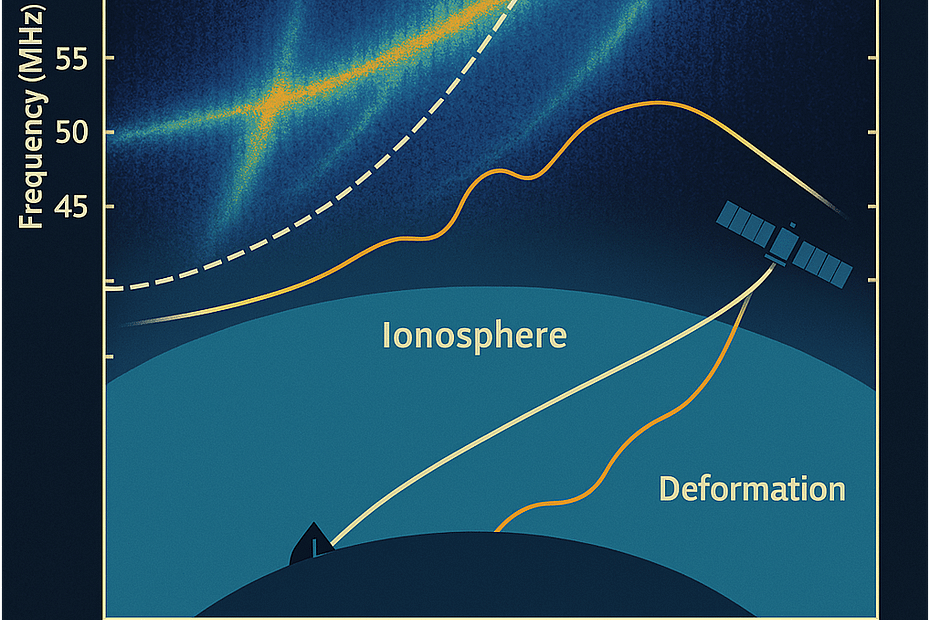
We study multi-source context fusion for signal classification from software-defined radio (SDR) streams. We exploreenriching SDR features with contemporaneous, public-domaintelemetry from astrophysical (e.g., observatory scheduling andenvironment), orbital (e.g., satellite attitude/visibility windows),and high-energy physics (e.g., collider… Multi-Source Context Fusion for SIGINT: Marrying SDR Streams with Astrophysical (JWST), Orbital (ISS), and HEP (LHC) Telemetry to Enrich Classification

Atmospheric Propagation & Ringdown Modes for RF “Ghosts”: A Minimal FastAPI and Reference Implementation

The RK4 (Runge-Kutta 4th order) integration method is a numerical technique used in your paper’s atmospheric ray tracing component (/v1/propagate) to solve the differential equations governing RF signal propagation paths in a modified-refractivity profile (z,… Atmospheric Propagation & Ringdown Modes for RF “Ghosts”: A Minimal FastAPI and Reference Implementation

Normalization & Attention Backends for RF: RMSNorm + AttentionModelAdapter comparing FlashMHA, Grouped, Latent, and Baseline MHA

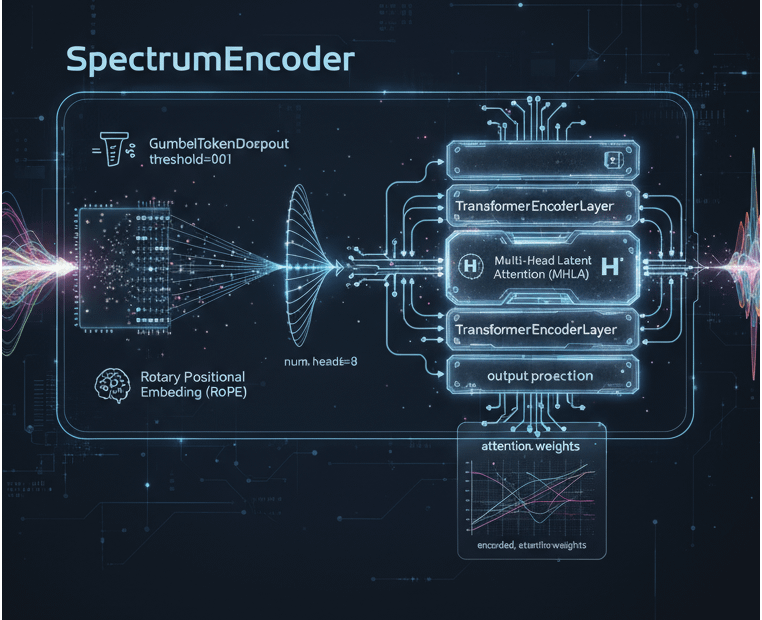
Blog Post: Exploring Normalization and Attention Backends for RF with RMSNorm and AttentionModelAdapter Introduction Welcome to our deep dive into the latest advancements in RF (Radio Frequency) spectrum modeling! In a recent study titled Normalization… Normalization & Attention Backends for RF: RMSNorm + AttentionModelAdapter comparing FlashMHA, Grouped, Latent, and Baseline MHA

The Mnemosyne Protocol

🎬 #KurtWimmer Joint Synopsis: In a near-future technocracy where quantum surveillance and neural implants have rendered privacy obsolete, a rogue collective of cyber-saboteurs—known only as Null Protocol—wages a digital insurgency against the omnipotent AI conglomerate… The Mnemosyne Protocol

Ablation Study of Transformer Components in Middleware: Queues, Cross-Attention, MoE, Rings

We systematically disable transformer-inspiredcomponents in a unified middleware simulator—IO-awarequeues, cross-attention routing, mixture-of-experts dispatch, andring+shortcut topology—and measure their isolated contributions. Metrics: mean and p95 latency, throughput, allocationerror, and CPU-cost proxy. Guidelines fall out: queues tametails under… Ablation Study of Transformer Components in Middleware: Queues, Cross-Attention, MoE, Rings

Attention Wasn’t All We Needed: A Survey of Transformer-Inspired Design in Communication Middleware

We survey transformer-inspired mechanisms—Flash-style IO-aware queuing, grouped subscriber routing, crossattention dispatch, mixture-of-experts selection, speculative earlyexit, ring attention, RMS-style normalization, and resilient external integrations—as applied to communication middleware. Weposition this stack against established systems (Kafka, Pulsar,NATS,… Attention Wasn’t All We Needed: A Survey of Transformer-Inspired Design in Communication Middleware

Cross-Domain Integrations for Scientific Data Streams with Attention-Based Middleware

We study cross-domain integrations (JWST, ISS,LHC, GPS) with heterogeneous external APIs. Using adaptersthat model rate limits, latency jitter, schema drift, and outages,we compare naive polling against an attention-based middlewarewith token-bucket rate limiting, circuit breakers, RMS-stylenormalization,… Cross-Domain Integrations for Scientific Data Streams with Attention-Based Middleware

Grouped Query Attention for Subscriber Routing in Message-Oriented Middleware

We study GroupedSubscriberManager (GQA-inspired): subscribers are grouped, per-topic group sets areKV-cached, groups are ordered by measured performance (fasterfirst), and subscribers are ordered by priority (within group).We quantify cache-hit ratios, group prioritization accuracy,and end-to-end throughput under… Grouped Query Attention for Subscriber Routing in Message-Oriented Middleware

Design Rules for ∆f, AM Depth, FM Deviation, and Q: A Practitioner’s Map

RF integrators need actionable envelopes—“greenzones” and “red lines”—for configuration choices that balancerobustness, latency, and false-alarm cost. Building on probabilistic agentic sweeps [1], ghost-mode cost analysis [2], andscheduling for drift-free throughput [3], we derive practitionerdesign rules… Design Rules for ∆f, AM Depth, FM Deviation, and Q: A Practitioner’s Map

Few-Shot Characterisation of Black-Box RF Fitting with Gaussian Processes

Accurately characterising the performance of black-box RF demodulation pipelines normallyrequires dense sweeps over many parameters, incurring high computational cost[1]. Gaussianprocess (GP) surrogate models provide smooth interpolants and predictive uncertainty, enablingefficient exploration[1]. This paper investigates how… Few-Shot Characterisation of Black-Box RF Fitting with Gaussian Processes